
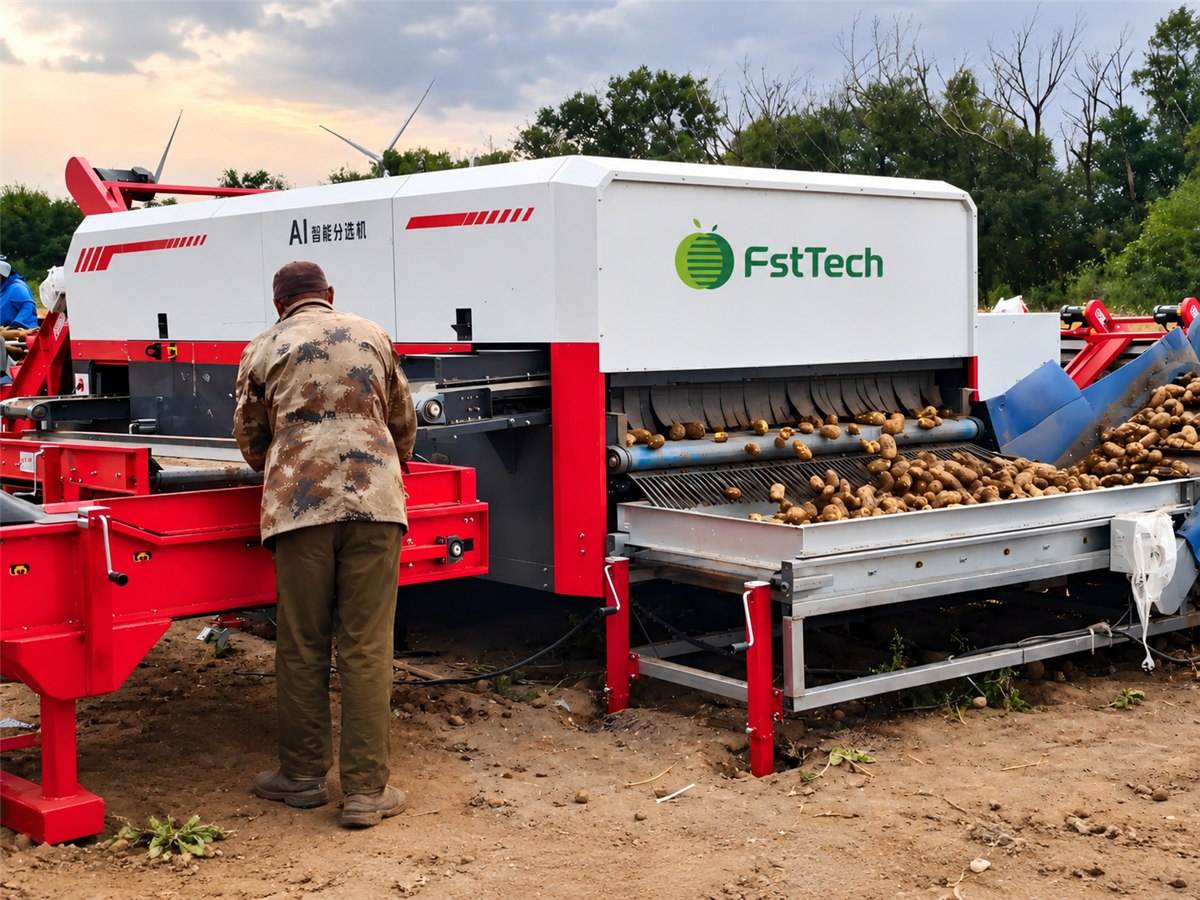
 Potato optical sorting machine
Sorting equipment
Potato Optical Sorting Machine
An AI optical sorting machine for potatoes and root crops — AI vision plus near-infrared spectroscopy removes soil clods, stones, rot and defects at up to 40 tons per hour, with a newer roller-bar generation available.
Applications
- Field-side potato sorting
- Warehouse quality control
- Processing plant preprocessing lines
- Carrots, ginger, sweet potato and cassava
Features
- Up to 40 t/h — belt typeThe belt-type AI sorter runs 30–40 t/h continuously — 24/7 ready for field-side and warehouse sorting.
- AI vision + near-infraredDual-source detection analyzes surface and internal quality; works on unwashed and washed potatoes.
- Rejection rate above 95% — belt typeSoil clod, rot and deformity detection exceeds 99%; mistaken rejection of good potatoes stays under 3%.
- Roller-bar generationA newer roller-bar conveyor design rotates each potato for all-around inspection — details below.
Technical Specifications
- Detection
- AI vision + near-infrared spectroscopy (dual source)
- Products
- Potato, carrot, ginger, sweet potato, cassava
- Power supply
- AC380V three-phase five-wire
- Use scenarios
- Field-side sorting, warehouse QC, processing lines
Structures
Belt Type vs Roller Bar
Belt-Type AI Potato Sorter
Belt-Type AI Potato SorterBuilt for fries and chips processors running multi-stage sorting. Potatoes travel on a wide belt at up to 40 t/h while high-pressure air jets strip field soil and stones at the source — where impurities can make up 25–30% of truck weight — cutting truck waiting time and transfer costs. Off-spec potatoes (for example mid-size ones) are separated early and diverted to food service or starch use. Note: potatoes do not rotate on the belt, so some surface defects can pass — typically used as the first of three sorting passes.
Both models: rejection rate above 95%, soil clod / rot / deformity detection above 99%, carryover under 3%, AC380V three-phase five-wire. Model number = capacity in t/h.
| Model | Belt width | Capacity | Inlet (W×H) | Total power | Dimensions (L×W×H) |
|---|---|---|---|---|---|
| FST-PS40 | 1,800 mm | 40 t/h | 1,800 × 1,700 mm | 30 kW | 5,000 × 3,000 × 1,860 mm |
| FST-PS30 | 1,200 mm | 30 t/h | Approx. 1,200 × 1,500 mm | On request | On request |
Roller-Bar Potato Sorter
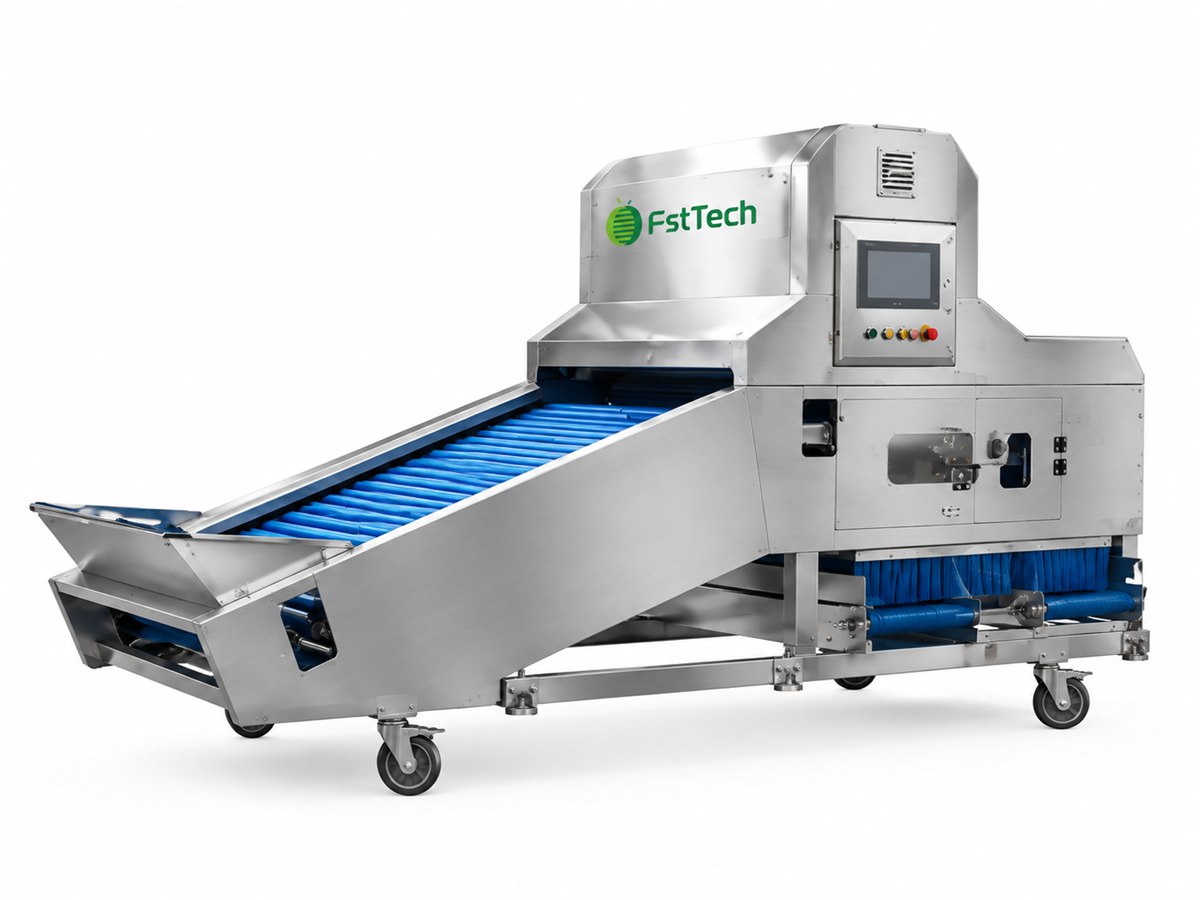 Roller-Bar Potato Sorter
Built for fresh-market and seed potato customers — packs must ship with no visible defects, because green heads, rot, deformities, breaks, insect holes, mechanical damage, stones or clods all hurt sale price or germination. Rotating roller bars turn each potato continuously so area-type cameras inspect every angle in a single pass, and a low-latency spring-finger ejector removes defects precisely. Stainless ASV design, working width up to 1,200 mm and up to 15 t/h — wider roller beds would deform under load. Waste outlet is selectable left or right for easy line integration.
Stainless ASV design: 360° roller rotation, AI vision + near-infrared dual detection, IP64 protection, working temperature -20 to 40 °C.
| Model | Roller bed width | Capacity | Air pressure | Power | Dimensions (L×W×H) |
|---|---|---|---|---|---|
| FST-PR15 | 1,200 mm (infeed 600–950 mm adjustable) | Up to 15 t/h | 0.2 ± 0.05 MPa | 7.5 kW, AC380V | 4,155 × 1,882 × 2,135 mm |
Working Process
Even spreading
Material is spread into a single layer for optimal detection coverage.
AI + NIR detection
AI vision cameras and near-infrared sensors capture surface and internal quality in real time, identifying soil clods, stones, green heads, rot, deformities, mechanical damage and off-size potatoes.
Automatic ejection
Defective potatoes are ejected automatically with over 95% rejection accuracy — the ejection mechanism is matched to each machine type.
Separated discharge
Good product and waste exit through separate outlets — the waste side is configurable left or right.
Working Video
FAQ
Can it sort unwashed potatoes straight from the field?
Yes — the AI vision + near-infrared system works on both soil-covered unwashed and washed potatoes.
Which type suits my business?
Fresh-market and seed potato growers choose the roller-bar sorter: 360° roller rotation lets cameras cover every angle and remove green heads, rot, deformities, breaks, insect holes and mechanical damage in one pass (up to 15 t/h, 1,200 mm width). Fries and chips processors choose the belt type: up to 40 t/h strips field soil and stones at the source — where impurities can be 25–30% of truck weight — cutting waiting and transfer costs, typically as the first of three sorting passes.
Which defects does it remove?
Soil clods, stones, green heads, rot, deformities, mechanical damage and off-size potatoes — detection exceeds 99% for soil clods, rot and deformities.
Which crops does it handle?
Potatoes, carrots, ginger, sweet potatoes, cassava and similar root crops; other products can be tested on request.